
The Hidden Cost of Starting Every Proposal From Scratch

A BD lead at a clinical research vendor recently described to me how she was going to have to skip an industry conference she had planned to attend. Not because the conference wasn't worth going to, but because an RFP dropped the week before and her team didn't have the bandwidth for both.
That's a familiar calculation for anyone who works in BD for a CRO or clinical service vendor. When an RFP or RFI comes in, everything else gets disrupted. The conference, the networking, the follow-up calls — all of it gets deprioritized to make sure the proposal gets done. And then the deadline passes, the proposal goes out, and the cycle starts again.
What rarely gets calculated is what that cycle actually costs.
The number nobody tracks
Industry estimates put a thorough clinical trial RFP response at 40 to 80 hours of effort for a mid-size CRO. I just heard the 80 hour number first-hand from a software vendor at a recent conference. That's a wide range and varies between a Phase I dose escalation study and a complex oncology or global multi-region Phase 3 trial. But even at the conservative figure, a team responding to ten proposals a month is committing 400 hours monthly to the proposal function. That's roughly ten full-time work weeks, every month, just in direct proposal effort.
That number gets accepted as the cost of doing business. What doesn't get calculated is how much of it is actually necessary, and how much is due to a lack of good systems and processes.
Start from scratch on every proposal and you're not just writing a new bid. You're re-solving problems that have already been solved. Finding the capability statement that was written for a similar study six months ago. Tracking down the version of the pharmacovigilance section that the medical director approved. Pulling the site performance data that lives in someone's email. Reconstructing the budget assumptions that were worked out for a comparable protocol last quarter.
This isn't proposal work. It's re-creating the wheel. Over and over..
The questionnaire problem is worse
Full RFP responses at least get the attention they warrant. Teams know they're time-intensive and plan accordingly. The damage done by smaller submissions — vendor qualification questionnaires, compliance forms, RFI responses — is harder to see because each one seems manageable.
A single questionnaire might take five to ten hours. Across a BD team fielding six to ten of these a month alongside their regular RFP volume, that's 30 to 100 hours of additional effort, often undercounted because no one treats it as a formal proposal process. The questions are standardised — "describe your data security practices," "list your GCP training protocols," "provide three references in this therapeutic area" — but the answers get written fresh each time, reviewed fresh each time, and approved fresh each time.
One BD Director recently described this experience: their current system rewrites pre-approved answers every time a questionnaire is processed, this forces a full review cycle even when nothing has changed. The content was correct to begin with. The system just made it untrustworthy triggering the full review process.
The compounding cost no one sees
Beyond the direct hours, there's a category of cost that doesn't show up in any time-tracking system: the opportunity cost of the proposals that don't get submitted, or get submitted at less than full quality, because the team is at capacity.
Every proposal team makes trade-offs. Which bids get full attention to write a complete capabilities narrative. Which just get last year's version with the dates updated. Which don't get submitted at all and which take a sneakily long time to finish, but actually have worse odds of success than the one that didn’t get submitted. Lack of insight into win/loss metrics, and the underlying contributing factors, is another symptom of inefficiency.
These decisions are often tactical in the moment, but over time their impact is deeply strategic to the company’s success. The proposals that didn't go out were potential opportunities that were missed. The bids that went out hastily, or “good enough”, to meet the deadline, were potential new relationships with future recurring revenue. The team member who spent forty hours rebuilding content that already existed was not spending those hours on the RFPs that required more thought and creativity.
That's the hidden cost. Not the hours you can count. The outcomes you can't.
What a different model looks like
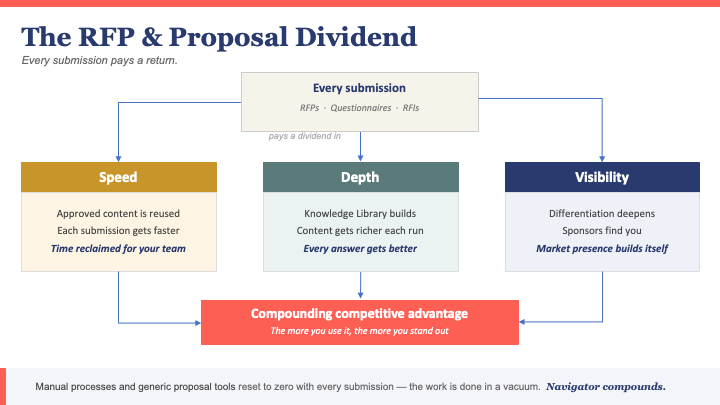
The teams that have solved this problem — genuinely solved it, not just organized their SharePoint folder differently — share a common characteristic: they've organized their institutional knowledge to be accessible, repeatable, and secure, while retaining flexibility with their tools and processes to still customize each proposal for the unique requirements of the sponsor.
The capability statement doesn't live in someone's head. It lives somewhere that can be found, reviewed, approved, and locked against unauthorized editing. The methodology section doesn't get rewritten for each new oncology RFP. It gets extracted, modified as needed, and incorporated into the proposal. The compliance questionnaire answers don't go through a full approval cycle because the system changed three words. They stay approved until someone with authority decides to change them.
The math shifts in this environment. Not because proposals take no time — they always will — but because the time goes toward the work that actually requires judgment and the unique contributions of your team that differentiate you from your competition.
The industry benchmark of 40 to 80 hours per response is an outdated paradigm.
Frequently asked questions
How long does it take a CRO to respond to a clinical trial RFP?
Most mid-size CROs spend 40 to 80 hours per RFP response — the equivalent of two full work weeks. Teams doing 10 proposals a month are committing 10 work weeks monthly just to proposals.
Why do CROs rebuild proposals from scratch every time?
Without a structured system for storing and reusing approved content, teams hunt through old emails and shared drives for last year's answers — then rebuild rather than retrieve. The content exists; the system to surface it doesn't.
What is a Knowledge Library in proposal automation?
A Knowledge Library is a searchable repository of pre-approved proposal content — capability statements, methodology sections, regulatory answers. DataCompass Navigator builds one automatically as your team approves answers, making each proposal faster than the last.
How does DataCompass Navigator reduce proposal time?
Navigator ingests the incoming RFP, matches each question against your Knowledge Library, locks approved answers so AI can't rewrite them, and flags only the gaps for human input. Teams typically cut response time in half on the first proposal and improve further from there.
Does proposal automation work for clinical trial compliance requirements?
DataCompass Navigator is built to clinical research compliance standards — content locking for regulatory consistency, built to SOC 2 Type 1 specifications, with HIPAA and 21 CFR Part 11 considerations throughout.